Public social media data is uniquely accessible and uniquely easy to misuse. The same browser tool that helps a journalist verify a public official’s claim can be used to build a stalking dossier on a private individual. The same follower-count check that supports a brand partnership decision can become an obsessive surveillance habit if repeated wrong.
Where the line sits between the two is not obvious. Public data being technically available does not automatically make every possible use of it responsible. This guide covers the ethical framework professional researchers, journalists and security teams have developed for using public profile data well, including the golden-rule test that catches most edge cases before they become problems.
Quick Answer
Responsible research means matching the tool to the task, respecting the account holder’s reasonable expectations and never compensating for lack of authorisation by aggregating data. Public profile viewers, follower checkers and Story downloaders are legitimate for professional research, journalism, competitive intelligence and personal curiosity. They become irresponsible when used to build dossiers on private individuals, create fake accounts, aggregate personal data into databases or extract information the account holder clearly did not intend to broadcast to the whole internet.
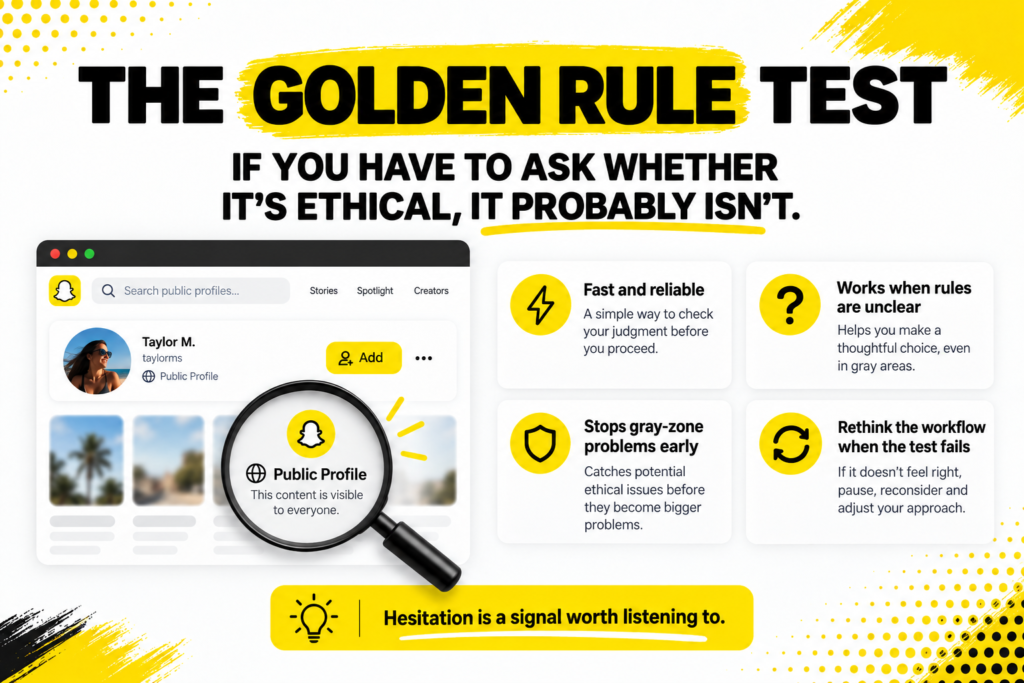
The Golden Rule Test
OSINT investigators have converged on one specific test that catches most edge cases.
If you have to ask yourself whether what you are doing is ethical, it probably is not.
The moment of hesitation is the signal. Ordinary research does not produce that hesitation. Checking a public follower count for a brand partnership does not feel wrong because it is not. Tracking a specific individual’s daily activity across their social profiles because you want to know where they are does produce that hesitation. That hesitation is worth listening to.
- The test is fast and reliable.
- It works even when written rules do not cover a situation.
- It stops most gray-zone problems before they escalate.
- When the test fails, the workflow needs rethinking rather than justifying.
The Core Principle: Consider the Intent
The single most important framing question for any public data use.
When somebody posts something publicly, what were they intending to share? And with whom? A creator posting a Story to their Public Profile intended it for anyone who might look. A person posting a birthday celebration on their personal account probably intended it for friends, even if the privacy settings technically allow anyone to see it.
- Content posted to public creator profiles.Clearly intended for open consumption. Research use is ordinary.
- Personal celebrations on default-public accounts.Technically visible but intended for a smaller audience. Aggregation crosses a line the account holder did not knowingly cross.
- Professional announcements.Intended for broad reach. Research use is ordinary.
- Family photos on a public account by accident.The account holder may not have realised they were public. Treating them the same as a professional creator’s content misreads the intent.
Intent is not a legal test. It is a professional judgment call that separates responsible research from technically-allowed-but-clearly-problematic use.
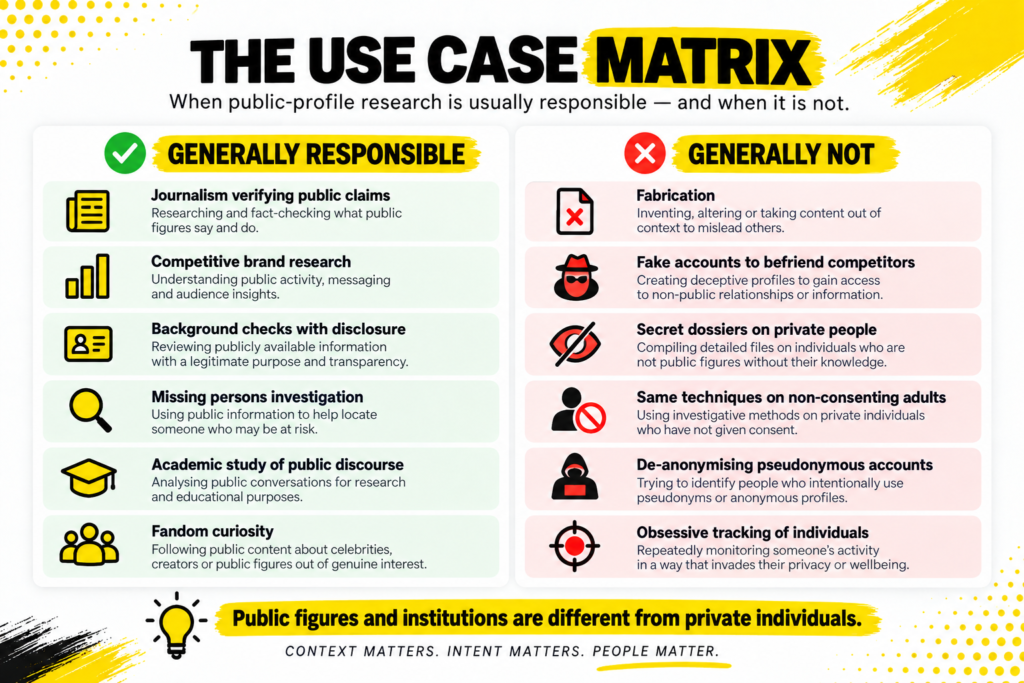
The Use Case Matrix
This table maps common research scenarios to whether they generally fall inside or outside responsible bounds.
| Use case | Generally responsible | Generally not |
|---|---|---|
| Journalism verifying public claims | Standard practice for accountability | Only becomes an issue with fabrication |
| Competitive brand research | Ordinary business intelligence | Fake accounts to befriend competitors |
| Background checks with disclosure | Standard with consent or notice | Secret dossier building on private people |
| Missing persons investigation | Legitimate humanitarian use | Same techniques on non-consenting adults |
| Academic study of public discourse | Ethics board oversight expected | De-anonymising pseudonymous accounts |
| Fandom curiosity | Ordinary if it stays casual | Obsessive tracking of individuals |
The pattern is consistent. Ordinary research on institutional or public-figure accounts is fine. Aggressive tracking of private individuals, fake account creation and building dossiers on non-public people is not.
The Line Snapchat Draws
Snapchat’s own architecture reinforces the responsible research framework. ThePublic Profile documentation explains that Public Profiles are the specific accounts users opted into for broader visibility. Everything else stays private by default.
- Public Profiles are the accounts users chose to make broadly visible.
- Personal accounts stay in the friend circle regardless of external tools.
- Under-16 accounts are entirely private with no public opt-in available.
- Ghost Mode hides location from all users including friends.
- Comment approval on Public Profiles gives creators control over what appears publicly.
The platform gives users specific controls to decide what becomes broadly researchable. Responsible research respects those controls even when technical workarounds might exist.
Behaviours That Are Consistently Out of Bounds
Professional OSINT communities have consensus on specific patterns that are never responsible regardless of stated intent.
- Creating fake accounts to befriend targets.Impersonation crosses both platform rules and ethical standards.
- Aggregating public profile data on private individuals into databases.Individual public posts are one thing. A structured database of everything a private person has ever posted is not the same category.
- De-anonymising pseudonymous accounts.If somebody deliberately posts under a pseudonym, unmasking them requires a very high bar.
- Publishing content that identifies non-public minors.Age creates a special protection that overrides technical availability.
- Coercing platform employees or using stolen credentials.At that point the activity is no longer OSINT at all.
- Reselling collected profile data.Turning public data into a commercial data product raises the responsibility bar substantially.
The Consent Question
When research needs consent versus when it does not.
- Public figures acting in their public capacity.No consent needed. Their public statements are legitimately researchable.
- Brand accounts and businesses.No consent needed. Business activity is subject to competitive intelligence.
- Private individuals in ordinary life.Consent or clear public interest justification is usually needed for anything beyond casual viewing.
- Employees of institutions being researched.Consent from the institution generally covers this. Individual employee consent is not typically required.
- Minors.Higher bar regardless of technical accessibility. Almost always needs both consent and institutional oversight.
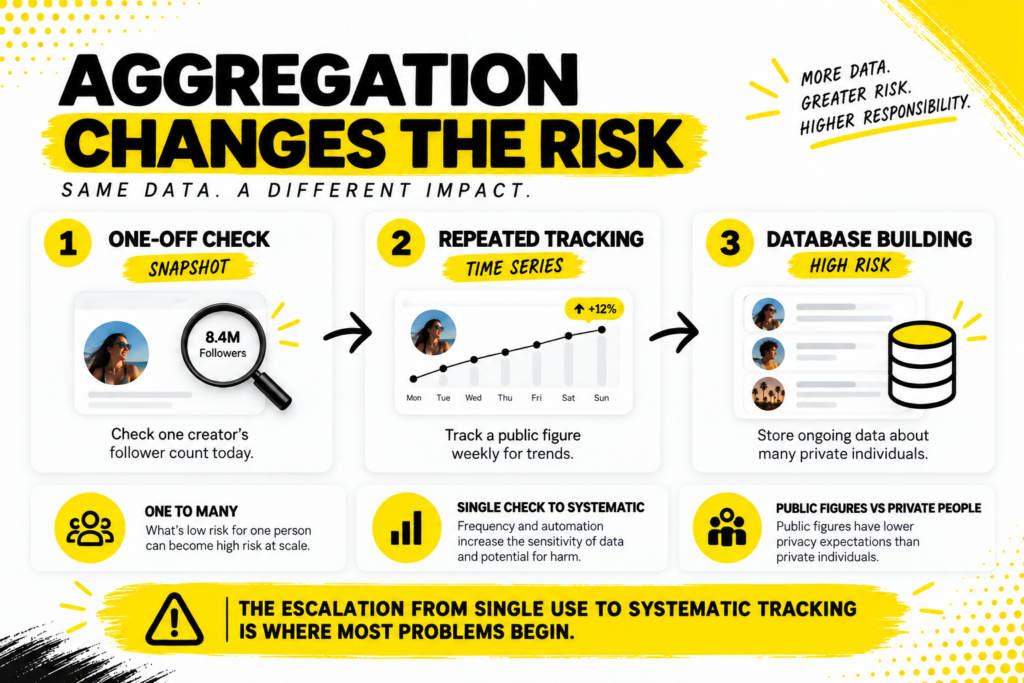
Aggregation Is Where Ordinary Use Becomes Problematic
One check is casual research. Structured aggregation is a different category.
Checking a specific creator’s follower count today is a snapshot. Checking it every day for six months and storing the results is a time series. Checking a hundred private individuals’ counts and building a database from them is something else again. The tool is the same. What changes is the use.
- One-off use is ordinary.
- Repeated tracking on public figures and institutions is ordinary business or journalism practice.
- Systematic tracking of private individuals shifts the responsibility profile substantially.
- Database creation from aggregated public data can trigger data protection frameworks in various jurisdictions.
The escalation from one to many, from single-check to systematic, is where most responsibility problems arise. Being aware of that escalation helps notice it happening.
When Research Serves Public Interest
The strongest justification for extensive research on public data is public interest.
- Accountability journalism.Verifying claims by public officials, powerful institutions and organisations with public influence.
- Corporate malfeasance investigation.Documenting patterns of misconduct by companies affecting the public.
- Missing persons cases.Following digital trails to help locate missing people.
- Extremism monitoring.Tracking public organising by groups planning harm.
- Academic research with ethics oversight.University-level research protocols provide safeguards against misuse.
Even legitimate public-interest use involves care. Just because researchers can publish something does not always mean they should.
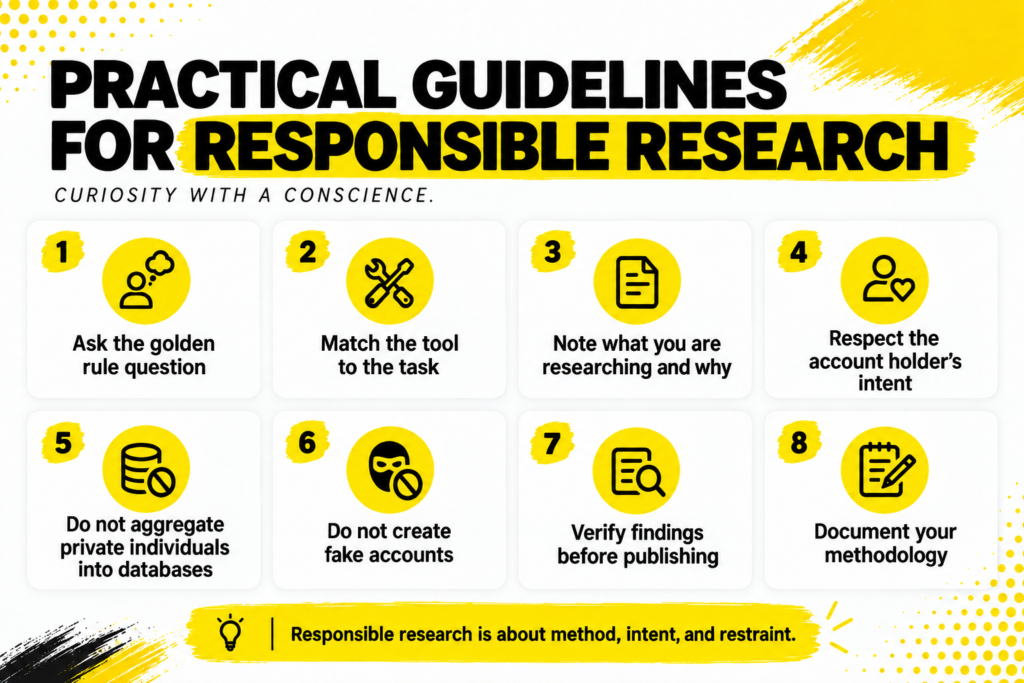
Practical Guidelines for Responsible Research
For anyone doing regular research on public social media data.
- Ask the golden rule question before starting any specific research task.
- Match the tool to the task. Casual viewing needs casual tools. Serious research needs structured methodology.
- Note what you are researching and why. A brief written intent statement clarifies your own thinking.
- Respect the account holder’s intent. Their reasonable expectations matter even when technical access exceeds them.
- Do not aggregate personal data on private individuals into databases.
- Do not create fake accounts or use false pretenses to access data.
- Verify findings before publishing. A single post is not evidence.
- Document your methodology if the research will be published or shared.
The Documentation Question
For research that will be shared or used in decisions, documentation matters.
- Note the source URL.So findings can be verified independently.
- Note the date and time of the check.Public data changes. What was true today may not be true next week.
- Screenshot when appropriate.Deletions happen. Contemporaneous screenshots preserve what was public at the moment of research.
- Note your methodology briefly.How did you find what you found? Reproducibility matters for verification.
- Note your specific research question.Findings out of context can mislead. Preserving the question preserves the interpretation.
Tools Are Not the Problem
Browser tools that read public data exist because the data is public. Snapchat’sthird-party apps guidance is specific about the boundary. Tools that require your Snapchat login can risk your account. Tools that read public data through browsers do not touch anyone’s account and do not raise the same concerns.
- The tools themselves are neutral.
- The use of the tools is where responsibility questions arise.
- A responsible researcher uses ordinary tools ordinarily.
- An irresponsible researcher would find ways to misuse any tool available.
Sites likeViewSnapStories provide browser-based access to public Snapchat data. The access itself is neutral. Whether the use is responsible depends entirely on the specific research task the user is conducting.
Common Rationalisations That Do Not Hold
Six arguments people make when their research feels wrong but they want to continue anyway.
- “It is public, so anything goes.”Public availability does not automatically make every use responsible. Intent still matters.
- “They should have made it private.”The account holder’s technical mistake does not transfer responsibility to them for others’ misuse.
- “I am just curious.”Curiosity is fine. Sustained tracking of a specific individual is not the same as curiosity.
- “Everybody does it.”Common practice is not automatically responsible practice. Frequency does not confer legitimacy.
- “It is for a good reason.”Good intent does not automatically make the method appropriate. Ends do not always justify means.
- “I would not care if somebody did it to me.”Your comfort with something being done to you does not represent everyone else’s comfort.
The Platform Rules Support Responsible Use
Snapchat’s privacy controls documentation explains the various settings users apply to their accounts. Those settings represent the account holders’ choices about their own visibility. Responsible research respects those choices.
- When somebody set their account to friends-only, they meant friends only.
- When somebody enabled a Public Profile, they consented to broader visibility.
- When somebody has Ghost Mode on, they specifically do not want location visible.
- When somebody manually approves comments, they want control over what appears on their profile.
Reading these signals accurately is part of responsible research. Ignoring them is where problems start.
Responsible Research FAQs
Is checking somebody’s public profile without their knowledge unethical?
Not inherently. Public data is by definition available without notification. The question is what you do with what you find and how systematic the tracking becomes.
Do I need permission to use public data for competitive research?
For research on business accounts and public figures acting in their public capacity, generally no. For private individuals, the calculation is different.
What if the data is public but somebody clearly did not mean to share it?
Intent matters. Technical availability does not automatically mean responsible use. Consider what the account holder would reasonably expect.
Are professional OSINT investigators required to disclose their identity?
Not always. But creating false pretenses through fake accounts or impersonation crosses widely-agreed lines.
One Framework, Countless Situations
The responsible research framework for public social media data is not a fixed list of rules. It is a set of principles that work across situations rules cannot anticipate. Consider intent. Respect reasonable expectations. Apply the golden rule test. Never compensate for lack of authorisation by aggregating instead. And always remember that public availability and responsible use are different questions.
Get these principles right and the tools become genuinely useful. Journalism gets better. Competitive research becomes ethical. Personal curiosity stays proportional. Get them wrong and the same tools become instruments for harm. The framework is what turns access into responsibility.