Five years ago, most third-party social media tools asked for a login as the first step. Give your credentials, grant permissions, then start using. That model was default across the category. Most users accepted it because there was no obvious alternative.
The default has flipped. In 2026, “no login required” is a headline feature rather than an unusual claim. Browser-based tools that read public data without any credentials have grown from a niche category into the mainstream way people interact with third-party social media utilities. This guide covers how that shift happened, the specific drivers behind the growth and where the category is heading next.
Quick Answer
No-login social media tools are browser-based utilities that read publicly available data from social platforms without requiring the user to sign in or grant credentials. The category has grown rapidly since 2020, driven by data breach fatigue, regulatory pressure from GDPR and state privacy laws, app fatigue, cross-platform convenience and rising general awareness of what login-based tools can actually access on user accounts. By 2026, credentials-first tools have shifted from default expectation to signal for extra caution.
What “No Login” Actually Means
Before covering the growth, worth being precise about the category.
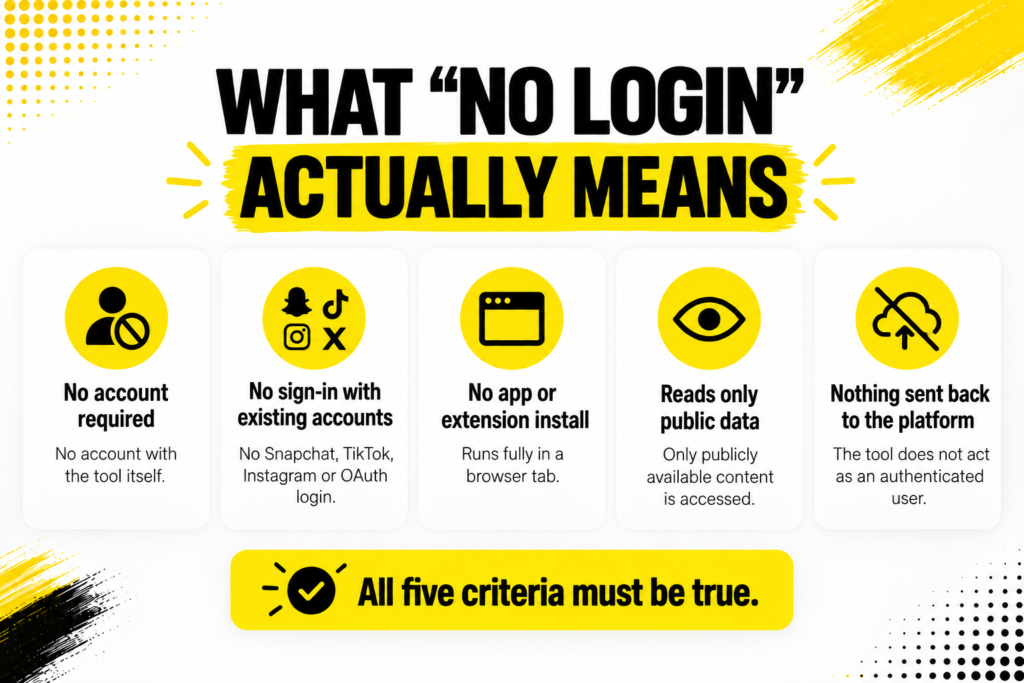
- No account required.Users do not create an account with the tool itself, on any platform.
- No sign-in with existing accounts.No Snapchat, TikTok, Instagram or third-party OAuth login flow.
- No app or extension install.The tool runs entirely in a browser tab.
- Reads only public data.The tool queries publicly published content, not anything behind privacy walls.
- Nothing sent back to the platform.The tool does not act as an authenticated user on any platform.
Meeting all five criteria is what genuine no-login tools do. Meeting four of five is not the same category.
The Historical Arc
The category evolution is worth walking through explicitly.
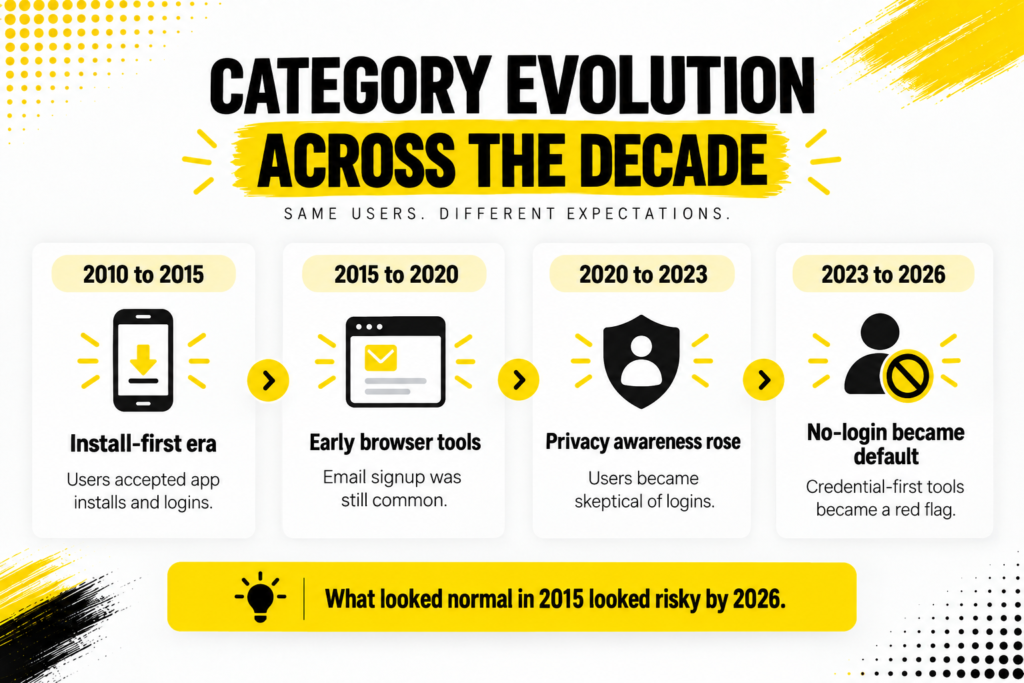
- 2010 to 2015.The install-first era. Every third-party social tool wanted an app install and login. Users largely accepted this because the internet had not yet reckoned with what “connected app” access actually meant.
- 2015 to 2020.Early browser-based scrapers emerged, mostly targeting Instagram. Still required email signup for most tools. Users started asking harder questions about permissions.
- 2020 to 2023.Post-Cambridge Analytica, privacy consciousness spiked. Data breach coverage became mainstream. Users began actively preferring tools that did not require credentials.
- 2023 to 2026.No-login became the default expectation for public data tools. Credentials-first tools now carry an implied warning rather than a neutral choice.
Category Evolution Across the Decade
This table shows how user expectations shifted with each era.
| Era | Dominant approach | What people accepted | What changed |
|---|---|---|---|
| 2010 to 2015 | App installs for everything | Sign in with Facebook | Data breach era began |
| 2015 to 2020 | Early scraper tools emerged | Give email for tool access | Cambridge Analytica happened |
| 2020 to 2023 | Privacy tools went mainstream | Some skepticism of logins | GDPR enforcement matured |
| 2023 to 2026 | No-login became a category | Login is a red flag | Privacy tools became default |
The pattern is consistent across every major platform. What users accepted in 2015 as a normal cost of using a tool became a red flag by 2026.
The Five Major Drivers Behind the Growth
The growth was not accidental. Five specific pressures converged to make no-login tools the mainstream choice.
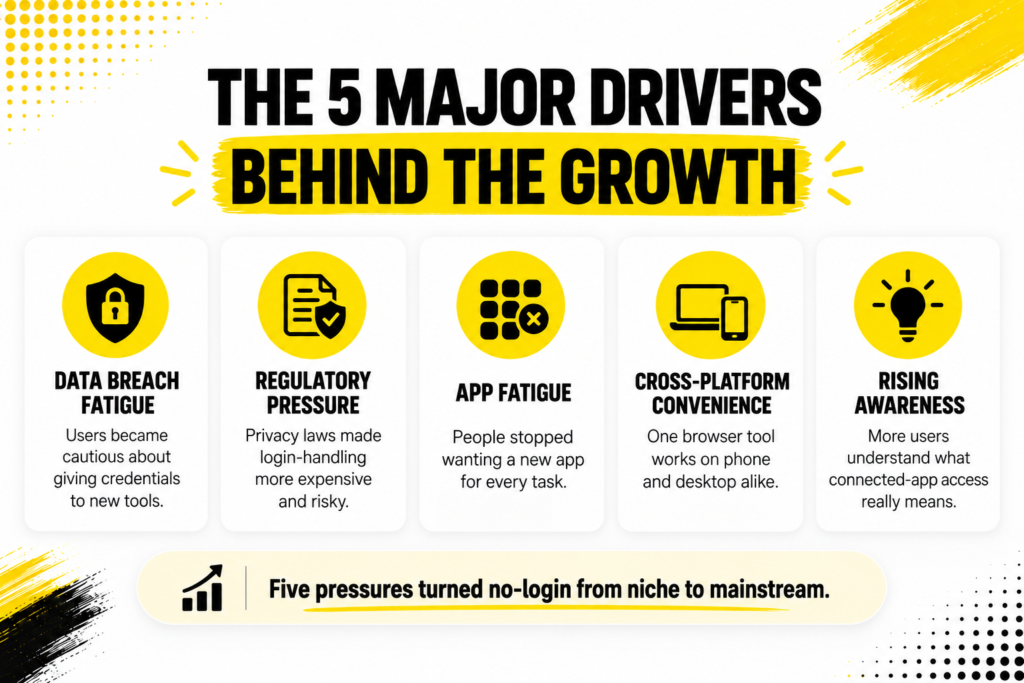
- Data breach fatigue.Users saw enough breaches at services that had their credentials to become cautious about giving credentials to any new tool. The reflex became: why give a login if the tool can work without one.
- Regulatory pressure.GDPR in Europe and privacy laws in over 20 US states shifted the calculation for tool builders. Handling logins carries compliance overhead. Not requiring them removes the overhead entirely.
- App fatigue.Users tired of installing new apps for every task. Browser-based tools that just work in a tab won by default against apps requiring installation.
- Cross-platform convenience.One browser tool works identically on iPhone, Android, Windows and Mac. Apps require separate installations on each. The convenience gap widened as multi-device use became universal.
- Rising general awareness.More users understand what “connected app” access actually means. That understanding shifted the default expectation from “of course I sign in” to “why does this need my login”.
Why Public Data Made the Category Possible at All
The technical foundation matters. Every major platform publishes some public data to the open web. Snapchat’sPublic Profile documentation explains that Public Profiles are visible to anyone on the platform, which by extension means anyone on the web. TikTok publishes profile pages at open URLs. Instagram publishes public content similarly. YouTube channels have public pages.
- The public data infrastructure already existed on every platform.
- No-login tools simply read that public infrastructure through browsers rather than through app APIs.
- Nothing about the approach requires the platform to change anything.
- The platforms cannot prevent browser tools from reading published data without also breaking legitimate search indexing.
This is why the category grew so quickly. The foundation was already in place. The tools just needed to be built on top of it.
The Regulatory Pressure Nobody Talks About Enough
The compliance angle drove more of the shift than most articles credit.
Building a tool that handles user credentials means complying with data protection laws in every jurisdiction where users live. GDPR alone requires proper consent flows, data processing agreements, breach notification within 72 hours and appointed data protection officers. Over 20 US states now have similar frameworks.
- Compliance cost.Real money for smaller tool builders. Six-figure annual overhead for anything at scale.
- Legal exposure.A single breach can result in fines that end a business.
- Ongoing burden.Compliance is not one-time. Regulations update, requirements shift, audits become part of operating.
- The alternative.Not requiring logins removes most of this compliance burden entirely. If the tool never touches user credentials, most data protection frameworks either do not apply or apply lightly.
For tool builders, the calculation became simple. Complicate the product with logins and inherit the compliance burden. Or simplify to no-login and sidestep most of it.
What Users Actually Started Wanting
The user-side shift matters equally.
- Zero-friction access.Users tired of “just create an account first” for every tool. The friction has real cost. No-login tools remove it entirely.
- Anonymity by default.Users noticed that logging in identified them to every tool they used. Not logging in kept things anonymous by design.
- Cross-device usability.Tools that work in a browser on any device beat tools requiring per-device logins.
- No password fatigue.Managing yet another password for yet another tool became annoying. Not needing one solved the problem.
- Trust through simplicity.Users increasingly trust tools that ask for less, not more. A tool that never requests credentials feels safer than one that promises to protect them.
The Platform Response
Platforms have mostly not fought this category. There are structural reasons why. Snapchat’sthird-party apps guidance explicitly warns against tools using login credentials, since those risk account locks. Tools that do not use credentials do not fall under this warning at all.
- Platforms actively discourage credential-using tools due to account safety.
- Platforms cannot easily discourage tools that only read public data.
- The distinction between the two categories effectively favours the no-login side.
- This structural dynamic has helped the no-login category grow with less platform resistance than expected.
Cross-Platform Reach
The no-login trend appeared everywhere at once.
- Snapchat.Profile viewers, Story downloaders and follower counters all shifted to no-login by 2023 to 2024.
- TikTok.Profile viewers, video downloaders and Story tools moved similarly.
- Instagram.Anonymous story viewers became a major category, mostly no-login.
- YouTube.Video downloaders and channel research tools mostly no-login by 2025.
- X (formerly Twitter).Post archivers and thread readers largely no-login now.
- LinkedIn.The main exception. Its aggressive anti-scraping stance kept most third-party tools requiring accounts.
Every consumer social platform saw the same pattern. Only LinkedIn resisted meaningfully. That resistance is one of the few outliers in an otherwise consistent industry trend.
The Use Cases Driving the Growth
The category grew because it served real needs.
- Content research.Marketers studying competitor content without their accounts appearing on viewer lists.
- Brand vetting.Verifying creator audience claims before partnerships.
- Archive building.Saving public content before it expires or gets deleted.
- Analytics research.Getting exact numbers instead of rounded platform-displayed versions.
- Reconnecting cleanly.Checking whether an old contact is still active without an obvious follow.
- Journalism.Reporters verifying public statements without their account creating a trail.
Sites likeViewSnapStories emerged specifically to serve these use cases across the Snapchat ecosystem. Similar tools exist for every other major platform. The unifying feature is what none of them ask for: your login.
What Comes Next
Predicting the future of any category is uncertain, but some trends look durable.
- More consolidation.Tool builders that already went no-login have less compliance risk, which lets them build sustainable businesses. The credentials-based competition is shrinking.
- Rising quality expectations.Users are no longer impressed by “no login required”. That is now baseline. Quality of data, speed of results and reliability become the differentiators.
- Platform pushback in specific areas.Platforms may add technical measures against specific tool categories they consider problematic, though enforcement remains difficult against pure browser-based tools.
- More granular regulations.New privacy laws may target specific behaviours rather than credentials-handling. Tool builders will need to watch how each new law applies to public data reading specifically.
- Cross-platform aggregators.Tools bundling multiple platforms into one interface. Already emerging. Likely to become a bigger part of the category.
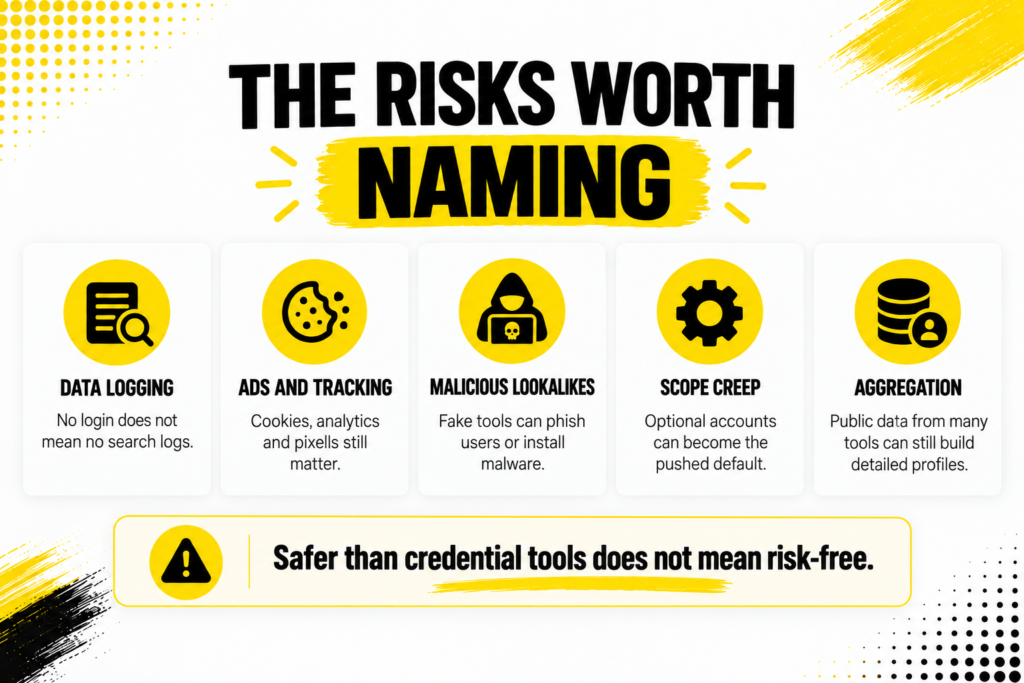
The Risks Worth Naming
Growth of a category is not the same as universal safety. Snapchat’s privacy controls documentation remains relevant to how users manage their own visibility. The no-login shift did not eliminate risks; it just changed which risks matter most.
- Data logging by tool providers.No login does not mean no data collection. Tools still log the queries users search.
- Ads and tracking.Free tools are usually ad-supported. Cookies, analytics and tracking pixels remain standard concerns.
- Malicious lookalikes.Popular no-login tools have fake versions that phish or install malware. Sticking to established tools matters.
- Scope creep.Tools that started no-login may add optional accounts for premium features. The optional often becomes the pushed default.
- Aggregation.Multiple tools all reading the same public data can build detailed profiles of individuals even without any single tool having credentials.
What Category Growth Actually Reveals
Zooming out, the growth of no-login social media tools tells a bigger story about how users relate to their digital identity.
- Users increasingly view credentials as valuable and worth protecting.
- Users increasingly view public data as a legitimate research resource.
- The distinction between the two categories is becoming a mainstream framework.
- Regulation has strengthened this framework rather than weakened it.
- Platforms mostly accept the framework, even when they have not endorsed it.
The no-login category is not just a tool category. It is an expression of how users have come to understand the relationship between their credentials and their public presence.
No-Login Growth FAQs
When did no-login become the default expectation?
Around 2023 to 2024, the shift became widely visible. Before that, no-login was one option among many. After that, credentials-first tools started needing to justify why they wanted logins at all.
Are no-login tools actually safer?
Safer against credential-related risks specifically. Not automatically safer against every risk. Data logging, ads and lookalike scams remain concerns.
Will platforms shut down no-login tools?
Some try. Enforcement against tools that only read publicly published data is technically difficult without breaking legitimate use cases like search indexing.
Do all social platforms have no-login tools available?
Most consumer social platforms do. LinkedIn is the notable exception, since its aggressive anti-scraping approach has kept most third-party tools requiring accounts.
A Default That Flipped in One Decade
The default expectation for third-party social media tools flipped in about ten years. What was normal in 2015 became optional in 2020, avoided in 2023 and a signal for caution by 2026. No-login browser tools now cover most user-facing tasks that used to require app installs and credential handoffs.
The shift reflects real changes in how users understand credentials, real regulatory pressures on tool builders and real structural advantages the browser-based approach has over app-based alternatives. The growth is not marketing hype. It is a category that grew because the specific combination of drivers behind it is unusually strong. The question for the next few years is not whether no-login stays the default. It is what quality bar the winners in the category clear to keep users choosing them.