Finding somebody’s social media handle used to be easy. Type their name, get their profile, move on. That model worked in an era when most people had one account on one platform. That platform indexed users by real name. Neither condition applies anymore.
In 2026, the average internet user has profiles across 5 to 8 different platforms, each with different username conventions, different character rules and different search behaviour. Username discovery has quietly become one of the harder tasks in casual research. Most articles still describe methods that worked in 2018. This guide covers the actual challenges people run into when trying to find somebody by username, the solutions that work today and the platform-specific quirks that make each service its own problem.
Quick Answer
Social media username discovery faces seven core challenges: character rules differ by platform, display names differ from usernames, private accounts hide from search, handle changes break old references, common names return thousands of matches, impersonators create false positives and no single search engine indexes all platforms uniformly. Working solutions combine cross-platform search tools, Google operators, contact syncing where available, systematic verification and platform-native search used correctly. No single method works everywhere. The right combination varies by which platform you are searching.
Why This Is Actually Hard
Being explicit about the technical reality.
- No universal username registry.There is no central directory of everyone’s handles across all platforms. Each service maintains its own user database.
- Platforms enforce different rules.Instagram accepts periods in usernames. X does not. Snapchat is strict about length. Reddit allows dashes but not spaces. Same person, different-looking handles across services.
- Handles change independently.Somebody may keep their Instagram handle for a decade while cycling through five TikTok handles. Old handles do not redirect.
- Display names complicate everything.The visible name on a profile is separate from the @handle. Search by one and you may miss the other.
- Privacy defaults hide many accounts.Private accounts appear less prominently in search. Some platforms hide them entirely.
Add these up and username discovery becomes a genuine research task rather than a lookup.
The Seven Core Challenges
The specific problems anyone doing username research runs into.
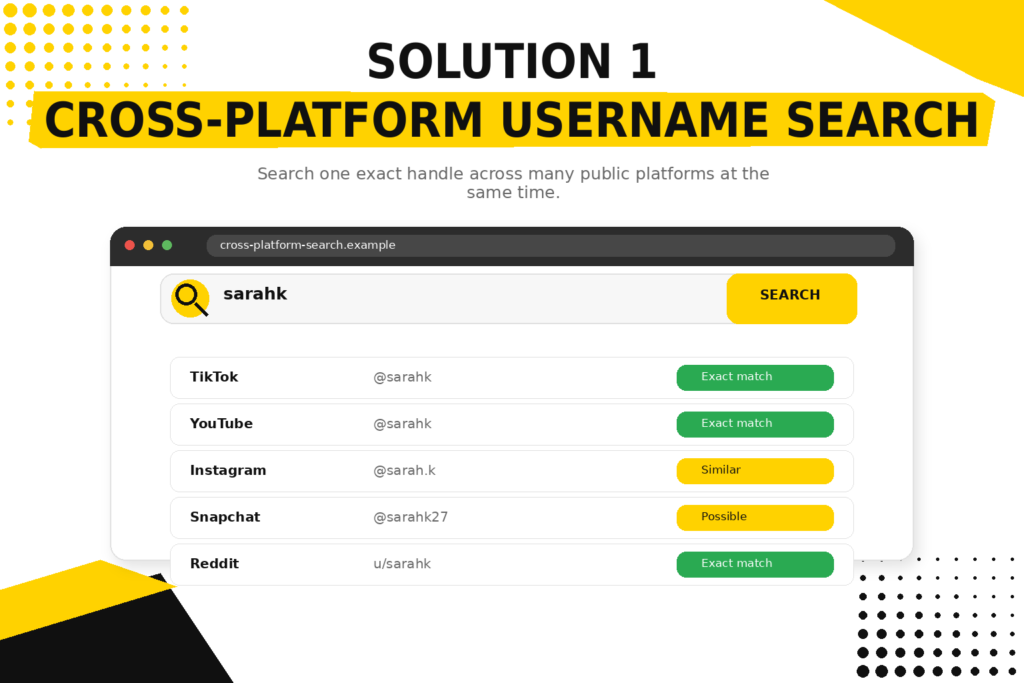
- Character rule mismatches.The same person may be @sarahk on TikTok, @sarah.k on Instagram, sarah_k on X and sarahk27 on Snapchat, all pointing to the same real person.
- Display name versus username confusion.People remember display names (“Sarah K”) but need usernames to find accounts. TikTok in particular makes this distinction consequential.
- Historical handle changes.The username you remember from three years ago may no longer point to the account. Nothing on the platform tells you what the new one is.
- Common name collisions.Searching “john” or “sarah” returns thousands of accounts. The right one may be buried 50 pages deep.
- Impersonator confusion.Fake accounts often use similar handles to real creators. Distinguishing them at a glance is not always possible.
- Private account invisibility.Private accounts appear less prominently in searches. Some cross-platform tools cannot see them at all.
- Platform search limitations.Snapchat has no public search interface at all. TikTok search algorithm prioritises differently than Instagram. Different platforms need different approaches.
Platform-Specific Character Rules
The specific rules that shape what handles can look like on each service.
| Platform | Character rules | Search quirk that trips people up |
|---|---|---|
| Snapchat | Letters, numbers, dots, dashes and underscores. 3 to 15 chars. | No public search, exact handle required |
| TikTok | Letters, numbers, dots, underscores. 2 to 24 chars. | Prioritises username starts over middle matches |
| Letters, numbers, dots, underscores. Up to 30 chars. | Different handles for personal and creator versions | |
| X (Twitter) | Letters, numbers, underscores. Up to 15 chars. No dots. | Case-insensitive but stored with original case |
| YouTube | Letters, numbers, dots, underscores, dashes. 3 to 30 chars. | Custom URLs versus channel handles |
| Letters, numbers, underscores, dashes. 3 to 20 chars. | Not aligned with display names ever |
Any cross-platform search has to account for these differences. A handle that works on Instagram may not have been technically possible on X due to character rules.
Solution 1: Cross-Platform Username Search Tools
The most direct solution to the multi-platform problem.
Tools designed specifically for cross-platform username search check the same handle against dozens or hundreds of platforms simultaneously. Enter a username once, get back a list of every platform where that exact handle exists.
- Coverage typically 100 to 500+ platforms.Includes major social networks, dating apps, gaming platforms, developer sites.
- Anonymous by design.Tools do not authenticate to platforms. The searched accounts receive no notification.
- Fast results.Under 60 seconds for a search across hundreds of platforms.
- Confidence scoring on some tools.Not every match is the same person. Better tools rank likelihood of same-person matches.
- Free tiers available.Basic cross-platform searches work without payment on most tools.
Solution 2: Google With site: Operators
The most powerful universal solution.
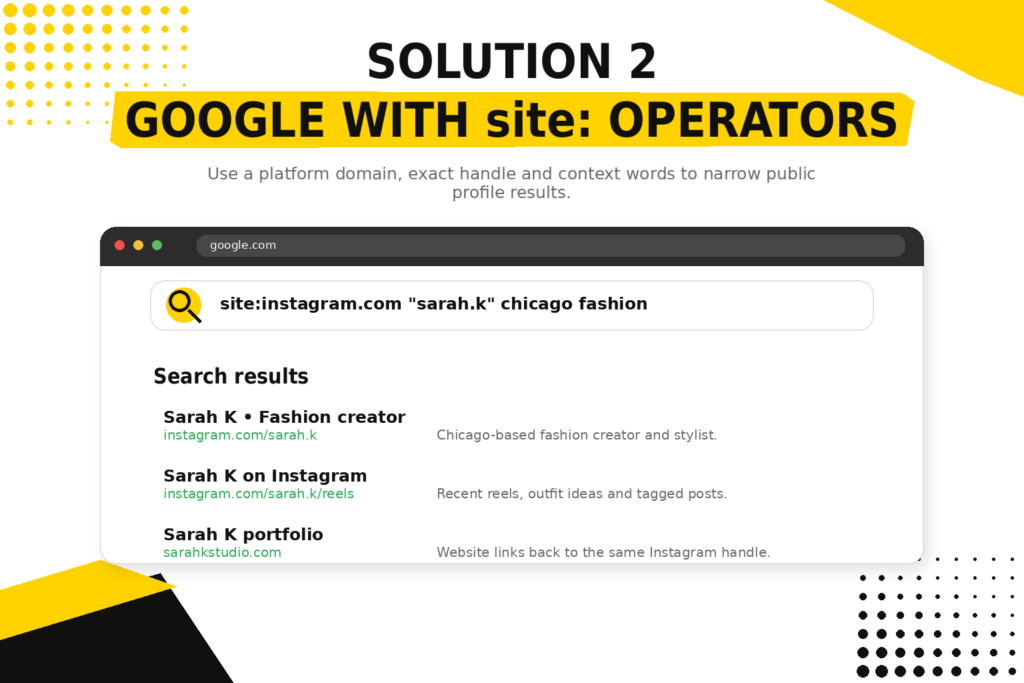
Google indexes public profiles across most platforms. Combined with the site: operator, it becomes a targeted cross-platform search that platform-native searches cannot match.
- Type site: followed by the platform domain:site:tiktok.com
- Add the username or partial username in quotes for exact matches.
- Add additional keywords: real name, city, niche.
- Repeat with different platforms: site:instagram.com, site:snapchat.com, site:x.com.
- Scan results for confirmed matches.
- Example.site:instagram.com “sarah.k” chicago fashion
- Why it works.Google’s search operators handle partial matches more flexibly than any platform’s in-app search.
- Cross-platform in one query.site:tiktok.com OR site:instagram.com covers two platforms simultaneously.
- Handles quotes for exact phrases.Quotation marks force exact matching.
Solution 3: Contact Syncing
Platform-native discovery through phone or email.
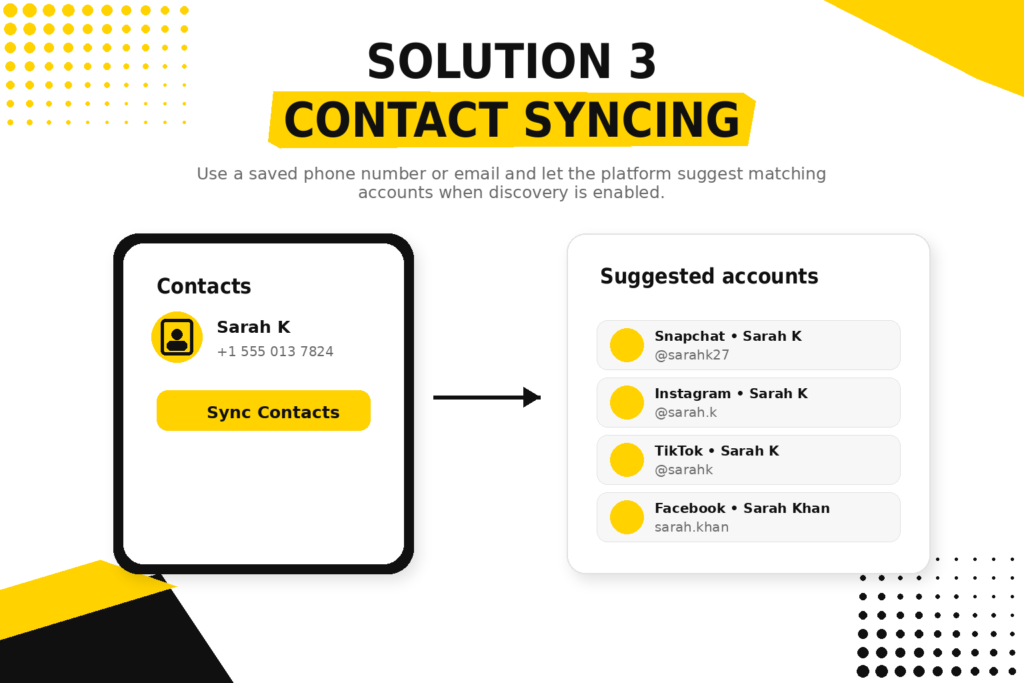
Most social platforms allow discovery through contact syncing. If you save somebody’s phone number to your contacts and enable contact syncing on Snapchat, TikTok, Instagram and Facebook, those apps may suggest their accounts. Snapchat’s Adding Friends documentation covers how the contact discovery feature works specifically.
- Works platform-natively.No third-party tool needed.
- Requires their number.If you do not have the person’s phone number, this method fails.
- Depends on their settings.If they disabled discovery by phone number, contact syncing will not surface them.
- Discreet but not invisible.The platform may notify them of the friend suggestion if they log in during the same session.
- Bidirectional.If you appear in their contact syncing, they may see you first.
Solution 4: Systematic Verification
The step everybody skips that catches most impersonators.
Once a candidate account is found, verification checks distinguish the real person from lookalikes.
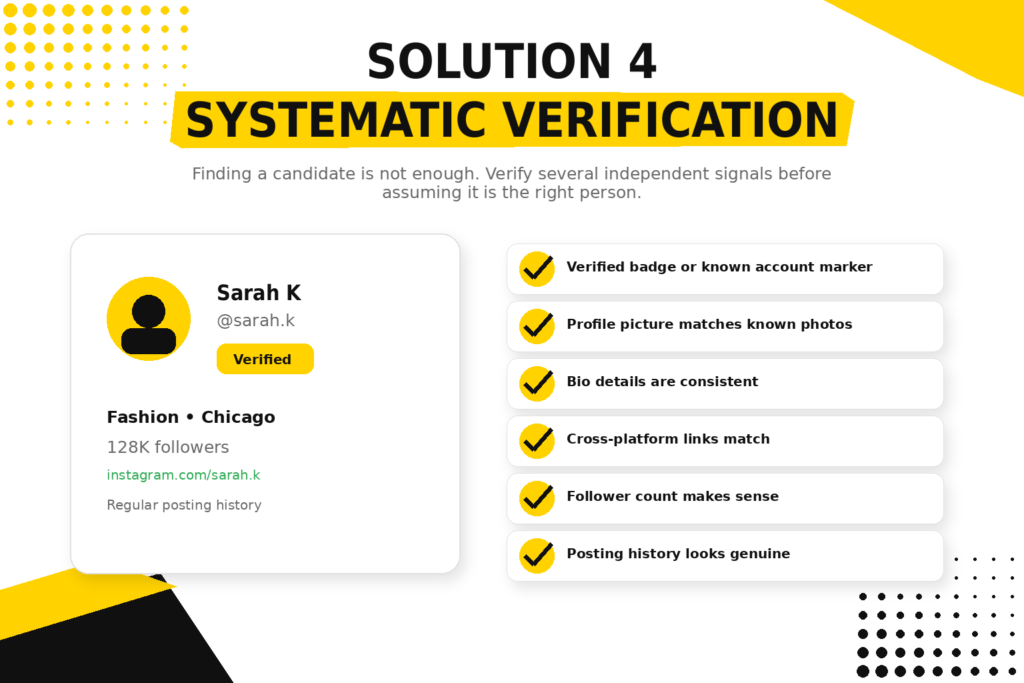
- Verified badge check.For public figures, the blue checkmark confirms the real account.
- Profile picture consistency.The real person’s photo. Compressed screenshots signal impersonation.
- Bio content accuracy.Real accounts often include personal or professional details that fake accounts do not.
- Cross-platform confirmation.If the bio links to their known Instagram or website, cross-check that those match.
- Follower count sanity check.Impersonators of established creators usually have far fewer followers than the real account.
- Post history quality.Genuine accounts have consistent posting history. Fake accounts often have sparse recent activity.
Solution 5: Snapchat Requires Its Own Approach
Snapchat is the special case. Snapchat’s username documentation explains that Snapchat identifies accounts by unique @handles like other platforms, but the app has no public search interface. You cannot search for users by browsing Snapchat itself.
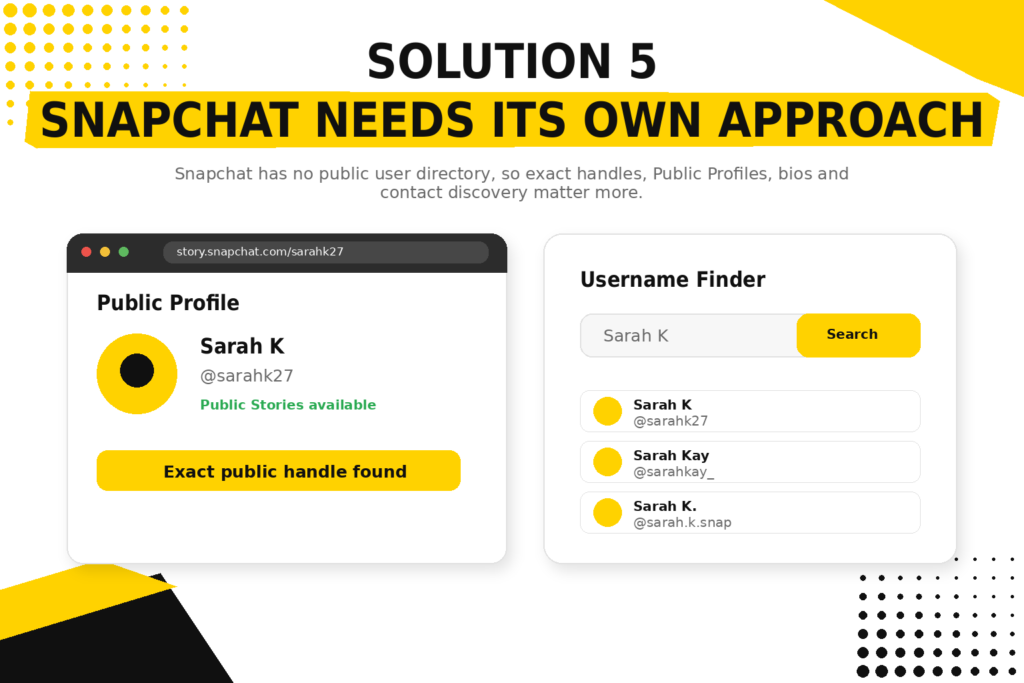
- No public directory.Snapchat does not publish a searchable index of user handles.
- Must know exact handle.To add somebody, you need their username or Snapcode.
- Public Profiles are the exception.Public Profiles publish at story.snapchat.com/username, which is web-indexable.
- Cross-platform bio search works.People often list their Snapchat username in Instagram, TikTok or X bios.
- Contact syncing works.If you have their phone number, contact syncing surfaces the account.
ASnapchat Username Finder fills the gap Snapchat itself leaves by making Public Profile handles searchable through a browser interface.
When Solutions All Fail
Being honest about the limits.
- Account is private.Private accounts across all platforms significantly reduce discoverability.
- Account was deleted.Deletion removes handles from platform databases entirely.
- Account was banned.Banned accounts return no results.
- Person never had that platform.Sometimes the handle you remember is from a different platform than you thought.
- Handle uses characters your keyboard cannot type.Some Unicode characters require special input methods.
- The person actively avoids discovery.If somebody set every platform to maximum privacy, external discovery becomes very difficult by design.
When two or three approaches fail on the same target, one of these is usually the reason.
The Cross-Platform Handle Reuse Pattern
One quiet fact that helps discovery work.
- Users under 25 particularly reuse handles.The username they picked on Snapchat or Instagram at 14 often carries to TikTok and other platforms they joined later.
- Convenience drives reuse.People default to handles they already remember when setting up new accounts.
- The reuse chain creates discovery paths.A username found on one platform often points to matching handles on others.
- Adaptations for character rules.When the exact handle is unavailable on a new platform, users often add underscores, dots, numbers or year suffixes.
- The pattern breaks for privacy-conscious users.Some users deliberately use different handles per platform for compartmentalisation.
Ethical Considerations
Being clear about the responsible use question.
- Casual research is ordinary.Finding an old friend or colleague on a new platform is a normal use of discovery tools.
- Professional verification is legitimate.Journalists, HR teams and business researchers use these tools for legitimate purposes.
- Systematic tracking crosses lines.Building a dossier on a specific individual across platforms shifts the responsibility profile substantially.
- Aggregation is the key concern.One check is research. Repeated tracking is monitoring. Combining data across platforms into a profile is different from any single lookup.
- Public data is public.But not every use of public data is neutral. Judgment about intent matters.
For Snapchat specifically, most searchable content sits onPublic Profiles, which users explicitly opted into for visibility. Discovery of Public Profile handles respects that opt-in.
When Handle Changes Happen
The specific problem of tracking somebody after they renamed.
- Old handles do not redirect.Once somebody changes their username, the old handle either becomes available for others to claim or shows a “not found” page.
- Google may still have the old version.Indexed pages predating the change reference the old handle. Sometimes this leads to their current profile through their bio or linked content.
- Cross-platform links may still work.If they linked their old TikTok handle in their Instagram bio and forgot to update it, that link still surfaces the current TikTok.
- New handles often echo old ones.People frequently rename to similar handles rather than radical changes.
- Third-party tools may have cached data.Old-handle searches may still return the new account if the tool tracks historical data.
The Systematic Discovery Workflow
When you need to find somebody methodically.
- Start with what you have: partial handle, real name, city or niche.
- Try cross-platform username tools first for exact-handle searches.
- If no exact matches, try Google with site: operators for each major platform.
- Add context keywords to narrow: city, niche, workplace.
- Verify candidate matches against your prior knowledge of the person.
- For Snapchat specifically, check their other platform bios for Snapchat handles.
- If contact syncing is an option, enable it and let platform-native discovery surface the account.
- If everything fails, ask the person directly or try alternate platforms.
The Verification Checklist Before Assuming You Found Them
Once a candidate account is identified.
- Profile picture matches known photos.
- Bio content aligns with what you know about them.
- Recent post history is consistent with their identity.
- Cross-platform bio links point to their other confirmed accounts.
- Follower count is in the range you would expect.
- Post language, tone or topics match their known style.
Any single confirmation can be forged. Multiple confirmations together provide high confidence.
Username Discovery FAQs
Do these tools work if the person has private accounts?
Partially. Cross-platform tools can often see that a handle exists on a platform even if the account is private, but they cannot see the private content itself.
Will the person know I searched for their username?
No. Username search tools operate without authenticating to platforms. No notification reaches the searched account.
Can I find somebody by their photo?
Some tools offer facial matching, but coverage is uneven and the ethical bar for this specific search is higher than for text-based lookups.
How accurate are cross-platform matches?
The same handle on two platforms often means the same person, but not always. Better tools score confidence rather than treating every match as definitive.
The Discovery Problem Is Not Solved, But It Is Solvable
Social media username discovery in 2026 is a genuine research challenge that combines platform quirks, character rules, privacy defaults and impersonation risks. No single tool works across every platform. No single method surfaces every account. The solution is not one tool but a workflow that combines cross-platform search, Google operators, contact syncing where appropriate, systematic verification and honest acknowledgment of when a search has genuinely failed.
Get the workflow right and most discovery tasks resolve in a few minutes. Get it wrong and the same task can eat an afternoon while producing the wrong result. The framework matters more than any specific tool. The willingness to combine approaches beats picking a favourite and hoping it works. Which is why serious username discovery has quietly become its own small skill worth learning properly.