Monitoring other creators’ public Snapchat profiles is not the same as casually checking them. Checking is a one-off. Monitoring is a system. Weekly rhythms, tracked signals, patterns emerging across months rather than snapshots that reveal nothing.
For creators serious about growing on Snapchat, competitor monitoring is one of the highest-leverage habits available. Snapchat gives creators zero built-in tools for tracking anyone but themselves. Building an external monitoring workflow fills that gap and turns competitor behaviour into actionable pattern recognition. This guide covers how creators actually set up that workflow, what signals matter and how to distinguish learning from copying.
Quick Answer
Creators monitor public Snapchat profiles through browser-based profile viewers that show public data without adding the observer to the target account’s viewer list. The workflow involves selecting 5 to 10 competitor accounts, checking them weekly, tracking specific signals in a simple spreadsheet and comparing patterns across months. All monitoring works only on public accounts (private ones do not expose data externally) and requires no Snapchat login on the observer’s side.
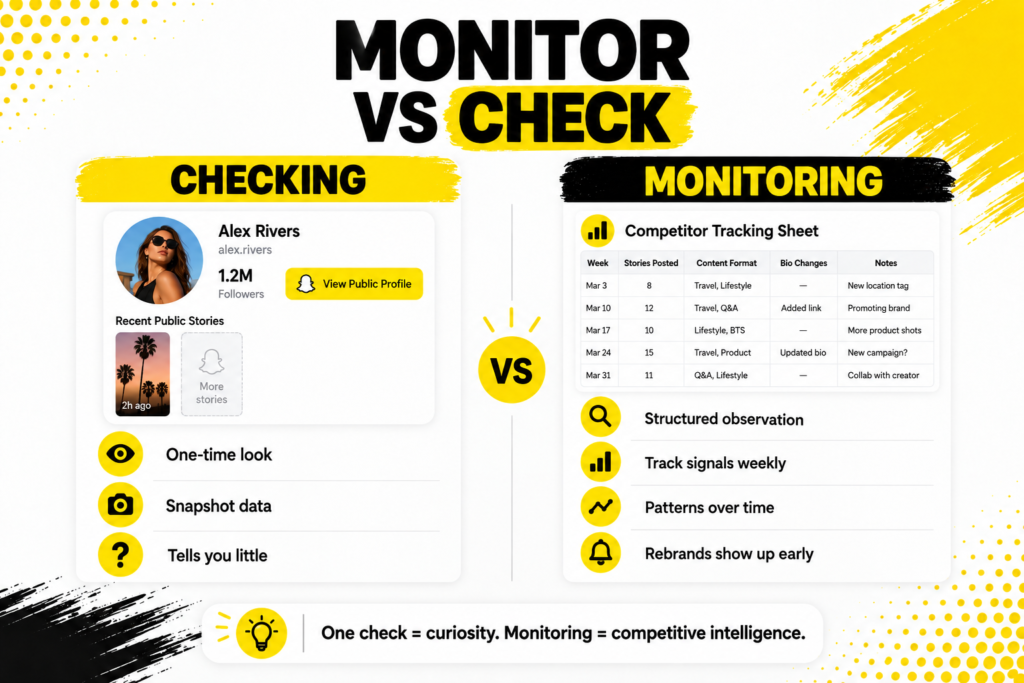
Monitor Versus Check: The Distinction
The word matters more than it seems.
- Checking.Opening a competitor’s profile once, seeing a follower number and closing the tab. Snapshot data.
- Monitoring.Ongoing structured observation, tracking specific signals over time, noticing changes and patterns.
- One check tells you nothing.Any single follower count or Story could be an outlier.
- Weekly monitoring tells you plenty.Trends emerge across weeks. Cadences become visible. Rebrands appear before they are announced.
The switch from checking to monitoring is what separates casual curiosity from actual competitive intelligence.
Why Monitoring Matters for Creators
This is worth being explicit about, since it is easy to dismiss monitoring as busywork.
- Pattern recognition.Successful creators in your niche follow patterns. Monitoring reveals those patterns before they become widespread knowledge.
- Trend detection early.New formats and hooks show up in top accounts weeks before smaller creators pick them up.
- Benchmark for your own growth.Your own numbers only mean something in comparison to accounts at similar size.
- Content idea validation.Before committing to a content series, seeing that competitors have tested similar angles is useful signal.
- Timing insights.When competitors post reveals when the audience is actually online.
- Rebrand warning.A competitor changing their bio, profile picture or posting cadence often precedes a strategic shift worth studying.
None of these come from a single check. All of them come from monitoring across time.
The Six Signals Worth Tracking
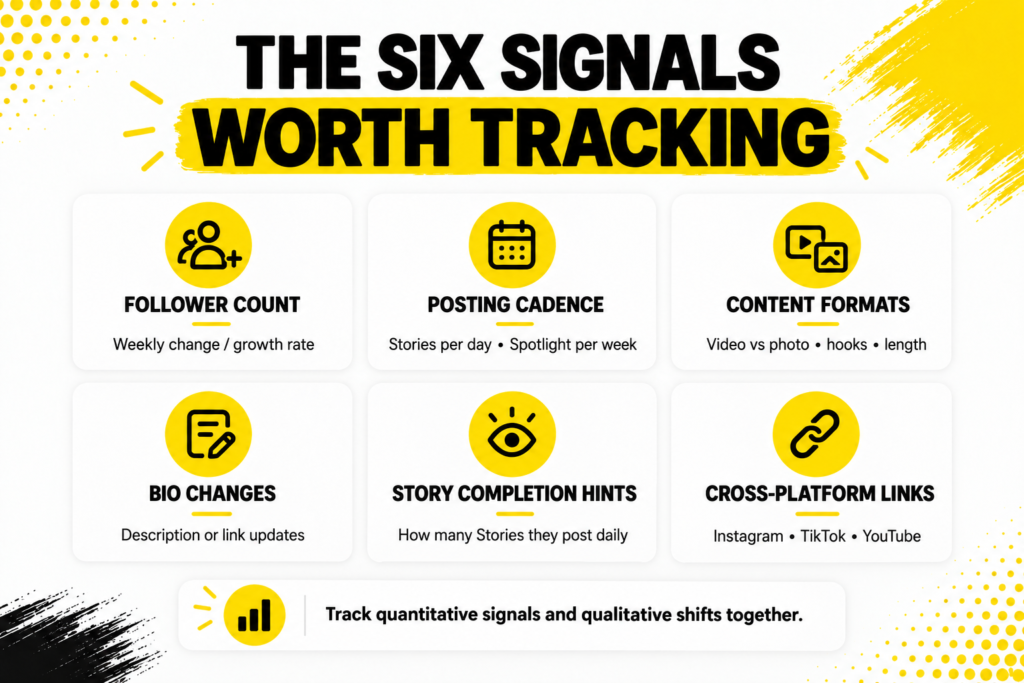
This table covers what to actually watch when monitoring a public Snapchat profile.
| Signal | What to track | Why it matters |
|---|---|---|
| Follower count | Weekly change, growth rate | Momentum trend, not just size |
| Posting cadence | Stories per day, Spotlight per week | What frequency works in the niche |
| Content formats | Video vs photo, length, hooks | Which formats are performing |
| Bio changes | Any update to description or link | Signals rebrands or new offers |
| Story completion rate hints | How many Stories they post daily | Confidence signal in their strategy |
| Cross-platform links | Instagram, TikTok, YouTube bio links | Where else they invest attention |
The first two rows are quantitative. The rest are qualitative but no less important for that. Both types matter for pattern recognition.
The Weekly Monitoring Rhythm
The exact frequency matters. Too often and you drown in noise. Too rare and you miss patterns.
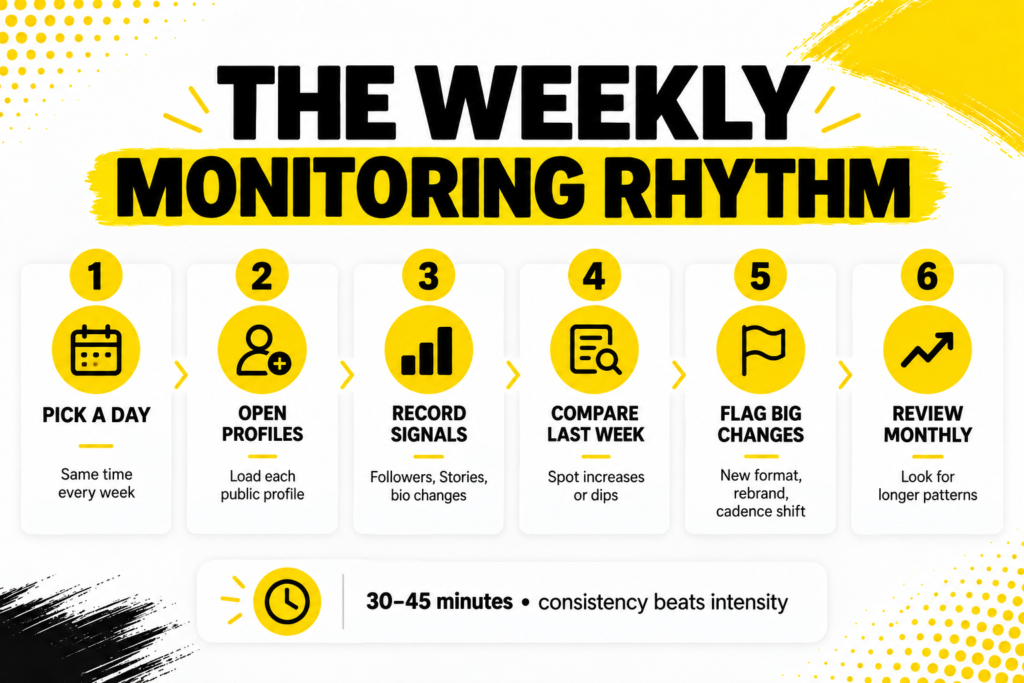
Weekly is the sweet spot for most creators. Once a week is often enough to see meaningful changes without being consumed by the process.
- Pick a specific day of the week. Sunday evening works well for many creators.
- Set aside 30 to 45 minutes.
- Open each monitored profile in a browser tab.
- Note the current signals in a tracking spreadsheet.
- Compare against the previous week’s notes.
- Flag anything that changed significantly.
- Consistency matters more than intensity. Weekly at the same time beats daily for a while and then nothing.
- Track the same signals each week. Comparability requires consistency.
- Note observations, not just numbers. “New format tested” is as valuable as “gained 5,000 followers”.
- Review the log monthly for patterns visible only across longer time windows.
The Browser-Based Anonymous Approach
Monitoring in the app carries a cost that a browser workflow avoids.
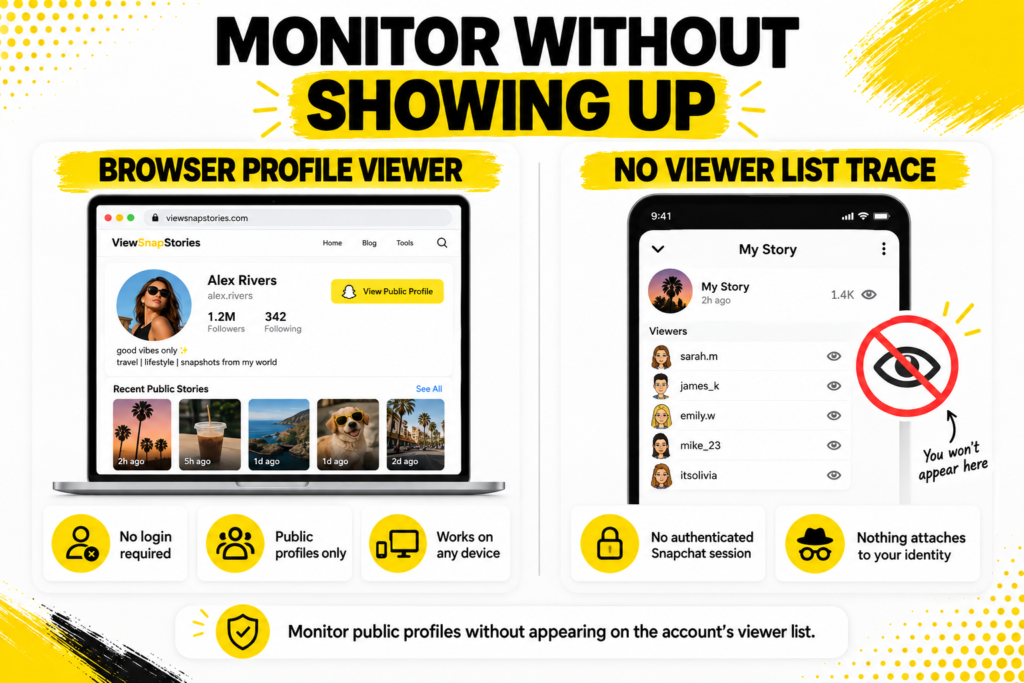
If you monitor competitors by opening their Stories in the Snapchat app, your username lands on their viewer list. Depending on the size of both accounts, this can be an obvious signal. A browser workflow avoids the whole issue.
ASnapchat Profile Viewer reads public profile data without touching Snapchat as an authenticated user. Nothing about the view attaches to your identity, so the target account has no signal that you were there.
- No trace on the target account’s viewer list.
- No login required on your side.
- Same data as the app shows for the public profile.
- Works on any device with a browser.
Setting Up a Simple Tracking Spreadsheet
The spreadsheet is the memory of your monitoring system.
A minimum viable tracking sheet has one row per competitor per week. Columns for follower count, Stories posted, notable content and any observations. Nothing fancy, but consistent enough that patterns become visible over time.
- Row per competitor per week.One line per account per Sunday check.
- Follower count column.Note the exact number, not the rounded version.
- Stories count column.How many Stories they had in the last 24 hours during your check.
- Notable content column.One sentence describing standout Story content, format experiment or engagement signal.
- Observations column.Free text for anything worth flagging: bio changes, rebrands, cadence shifts, cross-platform announcements.
After 8 to 12 weeks of consistent tracking, the sheet becomes a genuine competitive intelligence resource. Before that, it is just data. Patience matters here.
Scaling Monitoring Across Multiple Accounts
The workflow changes as the number of monitored accounts grows.
- 3 to 5 accounts.Weekly checks fit comfortably in 30 minutes. Manual monitoring works fine.
- 5 to 10 accounts.Weekly checks take 45 to 60 minutes. Bookmarking the profile viewer for each account saves time.
- 10 to 20 accounts.Weekly checks push toward 90 minutes. Consider batching by category, monitoring some accounts biweekly instead of weekly.
- 20+ accounts.Agency territory. Paid analytics platforms make more sense than manual tracking.
For most individual creators, 5 to 10 competitors covers the meaningful landscape. Snapchat’sPublic Profile documentation confirms that any account with a Public Profile is visible externally, so the pool of monitorable accounts in your niche is likely larger than you need to track.
The Learning vs Copying Line
This is the ethical question worth naming directly.
- Learning from patterns.Noticing that hook-first Stories perform better in your niche. Using that pattern in your own content.
- Studying formats.Recognising that a specific Story-plus-Spotlight combination works for competitors. Testing that combination for your own audience.
- Copying content.Reposting or closely imitating specific creative choices belongs to somebody else. Not the same as learning from patterns.
- The test.If your version could stand on its own without the competitor’s work as reference, it is learning. If it only makes sense as a copy, it is copying.
Successful creators monitor extensively and copy nothing. The patterns they notice become the seeds of their own experiments rather than templates for imitation.
When Patterns Become Insights
The gap between raw data and actionable insight is where monitoring earns its keep.
- One data point.Not an insight. Just a number.
- Three data points across three weeks.Suggestive but not conclusive.
- Consistent pattern across two months.Genuine insight worth acting on.
- Same pattern visible across multiple accounts.Strong signal about the niche as a whole.
- Pattern reversing across all accounts simultaneously.Major shift worth investigating urgently.
Most monitoring produces suggestive signals rather than clear insights. That is the nature of the work. The insights that do emerge are worth the extended observation.
What to Actually Do With the Data
Monitoring without action is just note-taking.
- Weekly content ideas.Patterns worth testing in your own content this week.
- Monthly format reviews.What is working across the niche that you could adapt.
- Quarterly strategy shifts.Major patterns suggesting your own strategy needs adjustment.
- Real-time reactions.If a competitor breaks major news, decide within hours whether to respond.
- Portfolio decisions.Which niches are growing fastest and where to allocate content investment.
Snapchat’sPublic Profile features documentation also mentions Insights, the built-in analytics for your own account. The combination of your own Insights plus your monitoring data on competitors builds the fullest possible picture of where you sit in your niche.
Common Mistakes During Monitoring
Five patterns that undo the value monitoring should deliver.
- Monitoring the wrong accounts.Tracking mega-creators when your niche has different dynamics is a waste. Match monitoring to accounts genuinely comparable to yours.
- Monitoring too often.Daily checks produce noise, not signal. Weekly is the sweet spot.
- Monitoring inconsistently.Two weeks on, three weeks off. Patterns need consistent data to become visible.
- Confusing following with monitoring.Following in the app is public engagement. Monitoring is anonymous observation. Different activities with different implications.
- Not writing anything down.Memory blurs across weeks. The spreadsheet or notes system is what turns monitoring into intelligence.
The Ethics of Anonymous Monitoring
Being honest about the boundary.
- Monitoring public data is standard competitive research across every industry.
- Anonymous access through browser tools does not violate anything. The data is public.
- Repeated obsessive tracking of a single personal account is different from professional competitive research.
- The Snapchat viewer list exists specifically to give the account owner control. Bypassing that through browser tools carries an obligation to use the access responsibly.
- If a competitor is genuinely a colleague or friend, mentioning the monitoring occasionally maintains transparency.
For Spotlight content specifically, Snapchat’s Spotlight documentation notes that Spotlight is public by design. Monitoring what performs on Spotlight is standard research territory.
Snapchat Monitoring FAQs
Will the account holder know I am monitoring them?
No. Browser tools do not touch Snapchat as an authenticated user, so no viewer list registration or notification reaches the monitored account.
How many accounts should I actually monitor?
For most creators, 5 to 10 competitors covers the meaningful landscape. More than 20 becomes agency territory that benefits from paid analytics.
Is competitive monitoring on Snapchat legal?
Reading publicly available data is standard practice. Snapchat publishes Public Profile content to open webpages. Reading those pages does not raise legal concerns.
Can I monitor private accounts?
No. Private accounts do not expose data externally. Monitoring only works on accounts with public profiles.
One Rhythm, One Sheet, One Growing Picture
Monitoring public Snapchat profiles turns competitor accounts from mysteries into readable signals. Not through single checks, which reveal nothing. Through weekly rhythms that build patterns across months. The workflow is simple. The value is compound. And the tools that make anonymous monitoring possible sit at a bookmark rather than an app install.
For creators serious about growing on Snapchat, the difference between running a monitoring system and not running one shows up in the quality of every strategic decision. The competitors you understand are the ones you can genuinely compete with.